Did you Cross Your "Red Sea"?


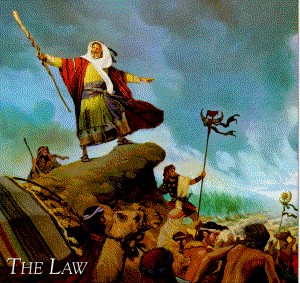
 Moses arms outstretched
"Then the Lord said to Moses, ‘Why are you crying out to me? Tell the Israelites to move on. Raise your staff and stretch out your hand over the sea to divide the water so that the Israelites can go through the sea on dry ground’ " (Exodus 14:15-16).
Our illustration captures the epic qualities of one of the most spectacular events in Old Testament history — the children of Israel crossing the Red Sea. The majestic figure of Moses dominates the scene. His rugged Midianite tunic, softened with decorative Egyptian cuffs, waistband and hem-tassels, is draped with a cloak of red, white and black — the same colors that would later identify the priestly Levites. His gleaming face, framed with the white linenkaffiyeh that hugs his head and shoulders, reflects his inspiration and determination. Moses’ staff and his outstretched arms seem to beckon the Israelites to safe passage.
From behind the rock, to Moses’ right, we catch a glimpse of Aaron staring intently at the parted waters. Beside the rock, to Moses’ left, stands the courageous figure of Joshua, who proudly carries the standard of the tribe of Ephraim. The insignia of Issachar can be seen at the lower right. This dramatic scene from the Exodus makes a fitting introduction to a study of the Pentateuch — the name commonly given to the five books of the law — because it vividly pictures God’s great plan of redemption for all humanity that these books begin to describe.
As you start your journey through the Bible, keep in mind that the great God who called Moses and the nation of Israel also wants to lead you. The same God who spoke to Moses speaks to you today. His message, alive and vibrant, is one told through the lives of men and women like Moses, Joshua and Miriam.
The apostle Paul realized this truth when he wrote to the church at Corinth: “Our forefathers were all under the cloud and…they all passed through the sea…. These things happened to them as examples and were written down as warnings for us, on whom the fulfillment of the ages has come” (1 Corinthians 10:111).
God speaks to all of us today. He speaks to you. So when you read of Moses, the tribes of Israel and Pharaoh’s armies at the Red Sea, remember that this is God speaking to you. Perhaps you are standing at a “Red Sea” of your own right now, being called out of the familiar and into the unknown journey ahead with God.
If you are, you need to answer some vital questions:

  • From what “Egypt” do you need to be freed?
  • Do you believe that God can provide you a way of escape?
  • Are you willing to follow his directions?

When you apply the truths of Scripture to your own life, you begin to appreciate their meaning and value more deeply. And you begin to hear God’s words of encouragement to you: “Do not be afraid. Stand firm and you will see the deliverance the Lord will bring you today” (Exodus 14:13).

Comments

Popular posts from this blog

Aspects of Information as Found in the Bible

by Dr. Werner Gitt on May 28, 2009 God is shown as the source or sender of biblical information. 14.1 God as Sender—Man as Recipient The five aspects of information—statistics, syntax, semantics, pragmatics, and apobetics—were discussed in chapter 4 , and it was stated that all five are indispensable for both the sender and the recipient. It is highly instructive to view the Bible in this way. Figure 27: God as sender; man as recipient. When God speaks in the Bible, He is the Sender of information. The message of the Bible, transmitted to us as recipients, can be analyzed according to the aspects of information, namely syntax, semantics, pragmatics, and apobetics. Only when we cover all the levels, will we achieve the purpose intended by God. Sender: In Figure 27, God is shown as the source or sender of biblical information. His Word is available to us today in completed ( Revelation 22: ) and written form (e.g., Exodus 17:14 ;...

Five Powerful Communication skills to Effectively Manage and Nurture Relationships

Every relationship, even with someone we've just met, begins with how we communicate.   Communication is the foundation of any relationship, reflecting the depth of our concern, joy, or other inner feelings toward the other person. Clear, affectionate, understanding, and honest communication strengthens bonds, potentially lasting a lifetime. In some friendships, there's a unique way of expressing wishes that deeply resonates with us, affirming the connection.   Others may communicate in a straightforward manner, signifying a relationship of convenience rather than depth. The way we communicate reveals how much we value the relationship—if we truly care, it will be evident in our words; if not, our communication will be limited to what is necessary.   Your relationship begins with your intent and your words. The right words can heal like a balm or cut like a knife. Your words matter.   Here are five powerful communication skills to effectively man...

Hudson Taylor's Testimony

Hudson Taylor’s Testimony There is nothing like reading salvation stories. Hudson Taylor’s (a British missionary to China who lived from 1832-1905) testimony is one of the greatest and most exciting salvation stories that I have read. Below you will see an excerpt from his autobiography where he tells the details of how God rescued him by His grace through the prayers of his mother. What a glorious Savior is Jesus! Here is the account: Let me tell you how God answered the prayers of my dear mother and of my beloved sister, now Mrs. Broomhall, for my conversion. On a day which I shall never forget, when I was about fifteen years of age, my dear mother being absent from home, I had a holiday, and in the afternoon looked through my father’s library to find some book with which to while away the unoccupied hours. Nothing attracting me, I turned over a little basket of pamphlets, and selected from amongst them a Gospel tract which looked interes...