The Name of God


 God's name in Hebrew
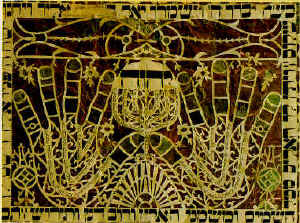
The Hebrew letters for God's name, YHWH (read from right to left), are framed by the star of David in a stained-glass window in Winchester Cathedral, England (above). YHWH, shown above a menorah (below), appears between hands extended in blessing in a 19th-century papercut from Morocco.
 papercut from Morocco
When God called to Moses out of the burning bush, telling him to free the Israelites from bondage in Egypt, Moses asked, “Suppose I go to the Israelites and say to then, ‘The God of your fathers has sent me to you,’ and they ask me, ‘What is his name?’ Then what shall I tell them?” (Exodus 3:13). God answered Moses, “I AM WHO I AM” (verse 14). The Hebrew word for “I AM” is ‘ehyeh, which comes from the verb “to be.” It can also be translated as “I SHALL BE.”
God further told Moses: “Say to the Israelites, ‘The LORD, the God of your fathers…has sent me to you’” (verse 15). Although the Hebrew word for “Lord” is ‘adon, the word translated “LORD” in verse 15 is different. Spelled with the four Hebrew consonants YHWH,it is known as the tetragrammaton (Greek for “four letters”). YHWH is related to ‘ehyeh and also comes from the verb “to be.” Both words have the sense of “being actively present.”
Although most scholars pronounce the tetragrammaton as Yahweh, the correct pronunciation is not known for certain. The Hebrews avoided saying the tetragrammaton because they believed that saying the personal name of God could take God’s name in vain. When reading a passage of the Hebrew Bible that contained it, they referred to God by another word —’adonai or “my Lord.”
The oldest known manuscript fragments of the Septuagint (the ancient Greek translation of the Old Testament) leave the tetragrammaton untranslated. However, later manuscripts, probably reflecting Christian editing, render the tetragrammaton as kyrios, Greek for “Lord.” Later, English versions rendered the personal name YHWH as the impersonal “the LORD.” They used all capital letters for “LORD” to indicate they were translating YHWH, not ‘adon or ’adonai.
The text of the Hebrew Bible originally consisted of consonants only. When vowel marks were added in the 10th century A.D., the vowel marks of ‘adonai were used for the tetragrammaton to remind the reader to say ‘adonai instead of trying to pronounce the divine name.
When Latin translators in the 16th century came upon this combination, they transliterated, using the consonants of YHWH and the vowels of ‘adonai, creating the artificial form Iohoua. In 1530, Tyndale rendered the tetragrammaton as Iehouah in his Old English translation ofExodus 6:3. (As with many other words in that era, I was used for J, and U for V.) Subsequently, Jehovah became the standard spelling, and this appears at a few places in the King James Version (in Psalm 83:18, for example). However, in the vast majority of cases, the King James Version translates YHWH as “the LORD” and ‘adonai as “the Lord.”

Comments

Popular posts from this blog

Aspects of Information as Found in the Bible

by Dr. Werner Gitt on May 28, 2009 God is shown as the source or sender of biblical information. 14.1 God as Sender—Man as Recipient The five aspects of information—statistics, syntax, semantics, pragmatics, and apobetics—were discussed in chapter 4 , and it was stated that all five are indispensable for both the sender and the recipient. It is highly instructive to view the Bible in this way. Figure 27: God as sender; man as recipient. When God speaks in the Bible, He is the Sender of information. The message of the Bible, transmitted to us as recipients, can be analyzed according to the aspects of information, namely syntax, semantics, pragmatics, and apobetics. Only when we cover all the levels, will we achieve the purpose intended by God. Sender: In Figure 27, God is shown as the source or sender of biblical information. His Word is available to us today in completed ( Revelation 22: ) and written form (e.g., Exodus 17:14 ;...

Five Powerful Communication skills to Effectively Manage and Nurture Relationships

Every relationship, even with someone we've just met, begins with how we communicate.   Communication is the foundation of any relationship, reflecting the depth of our concern, joy, or other inner feelings toward the other person. Clear, affectionate, understanding, and honest communication strengthens bonds, potentially lasting a lifetime. In some friendships, there's a unique way of expressing wishes that deeply resonates with us, affirming the connection.   Others may communicate in a straightforward manner, signifying a relationship of convenience rather than depth. The way we communicate reveals how much we value the relationship—if we truly care, it will be evident in our words; if not, our communication will be limited to what is necessary.   Your relationship begins with your intent and your words. The right words can heal like a balm or cut like a knife. Your words matter.   Here are five powerful communication skills to effectively man...

Hudson Taylor's Testimony

Hudson Taylor’s Testimony There is nothing like reading salvation stories. Hudson Taylor’s (a British missionary to China who lived from 1832-1905) testimony is one of the greatest and most exciting salvation stories that I have read. Below you will see an excerpt from his autobiography where he tells the details of how God rescued him by His grace through the prayers of his mother. What a glorious Savior is Jesus! Here is the account: Let me tell you how God answered the prayers of my dear mother and of my beloved sister, now Mrs. Broomhall, for my conversion. On a day which I shall never forget, when I was about fifteen years of age, my dear mother being absent from home, I had a holiday, and in the afternoon looked through my father’s library to find some book with which to while away the unoccupied hours. Nothing attracting me, I turned over a little basket of pamphlets, and selected from amongst them a Gospel tract which looked interes...